
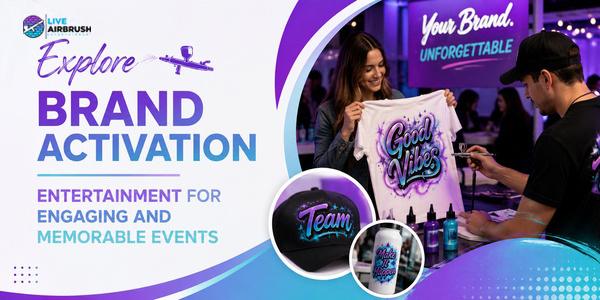

Brand activation entertainment is live, interactive entertainment designed to get people engaging with a brand in person, so they remember the experience and not just the logo. It ranges from DJs and roving performers to photo experiences, games, immersive tech, and live art, where an artist customizes merch for each guest while they watch.
The right format depends on your audience, your budget, your venue, and the one thing you want guests to do afterward. This guide covers seven formats, compares them side by side, explains what drives cost, and gives you a checklist for choosing.
What Is Brand Activation Entertainment?
A brand activation is any experience that moves someone from being aware of your brand to actually doing something with it: trying a product, signing up, posting a photo, or taking something home. Entertainment is the engine. It gives people a reason to stop, stay, and talk about what they saw.
Three things separate strong activation entertainment from a plain sponsor booth:
- Participation. Guests do something instead of just watching or collecting a flyer.
- A takeaway. A photo, a clip, a product, or a story they want to share.
- A natural fit with the brand. The experience should feel like it belongs to your brand, not like a random show with a logo on it.
This kind of entertainment shows up at product launches, trade show booths, retail pop-ups and grand openings, festivals and sponsored gatherings, college campus tours, and co-branded campaigns. If you are still shaping the concept, our pop-up brand activation ideas are a good companion read.
Why Live Entertainment Beats a Static Brand Table
When someone gets a free item from a table, they take it, say thanks, and move on. There is no moment attached to it, and most of it is forgotten by the time guests reach the parking lot.
Live entertainment changes three things:
- Dwell time. People stay longer when something is happening in front of them.
- Crowd effect. When one person stops to watch, others drift over to see what is going on. That is free, organic attention for your brand, and a static table rarely creates it.
- Shareability. A live moment gives guests something to film, photograph, and talk about.
The catch is that not every format delivers all three. That is why the next section matters.
7 Types of Brand Activation Entertainment
1. Live music and DJs
Strength: Energy and crowd size. Great for launches, festivals, and sponsored stages.
Trade-offs: Sound competes with conversation, and guests are mostly passive spectators. It works best when paired with a second, interactive element that gives people something to do.
2. Roving performers and street acts
Think stilt walkers, magicians, dancers, and costumed characters.
Strength: They grab attention in busy venues and can steer foot traffic toward your booth.
Trade-offs: Attention can be fleeting. Brief performers to direct people to one specific place or action.
3. Photo, video, and social experiences
Photo booths, 360-degree cameras, branded backdrops, and AR filters.
Strength: Sharing is built in, and branding is easy to add.
Trade-offs: It is a crowded category, so you need a creative concept to stand out, and the takeaway is usually a digital file rather than something physical.
4. Games and competitions
Oversized games, skill challenges, prize wheels, and tournaments.
Strength: High participation, and a natural place to collect sign-ups.
Trade-offs: Needs space and staff, and can feel gimmicky if the game has nothing to do with your brand.
5. Immersive and AR/VR experiences
Strength: Novelty, and the ability to show a product or story in ways a physical setup cannot.
Trade-offs: Higher production cost, one-person-at-a-time throughput that creates lines, and technical risk on event day.
6. Live art and on-site customization
This is the format Live Airbrush specializes in. An artist customizes items on-site, such as T-shirts, trucker hats, hoodies, sweatshirts, socks, and tote bags, while guests watch the work happen. Our live airbrush brand activations turn a five-second handout into something people stop, watch, and wear home.
Strength: Guests see real craft, leave with a physical keepsake made for them, and the process itself pulls in a crowd. A wearable item also keeps your brand visible long after the event ends.
Trade-offs: Output is limited by the number of artists, so capacity planning matters (see the example below). It also needs table space and advance planning for the items being customized.
7. Talent and creator appearances
Athletes, influencers, creators, and local personalities.
Strength: They draw a crowd and extend your social reach.
Trade-offs: Fees can be high, crowd control matters, and the value depends entirely on how well the person fits your audience. Pair the appearance with something guests can take part in.
Side-by-Side Comparison
| Format | Best for | Biggest strength | Watch out for | Relative cost |
|---|---|---|---|---|
| Live music / DJs | Launches, festivals | Energy and crowd size | Passive audience, noise | Medium to high |
| Roving performers | Busy venues, trade shows | Foot traffic | Fleeting attention | Low to medium |
| Photo / video / AR filters | Social reach | Easy sharing | Crowded category | Low to medium |
| Games and competitions | Sign-ups, sponsorships | High participation | Space and staffing | Low to high |
| Immersive AR/VR | Product demos, tech brands | Novelty | Lines, tech risk | High |
| Live art / customization | Pop-ups, trade shows, campus events, brand activations | Physical keepsake plus crowd effect | Capacity planning | Medium |
| Talent / creators | Large launches | Draws a crowd | Fees, crowd control | High |
Relative cost is a rough guide only. Real pricing depends on scope, location, and timing.
How to Choose: A Practical Checklist
Before you request quotes, answer these questions:
- What is the one action you want guests to take? Sign up, try the product, post online, visit a booth, or buy.
- Who is the audience? Students, executives, families, and festival crowds respond to very different things.
- How many people will attend, and how many will realistically participate? Participation is usually a fraction of attendance.
- How long is the event, and when is the busiest window? Match the format to the peak.
- What space do you have? Check footprint, power, indoor versus outdoor, and foot-traffic flow.
- What will guests take home? A physical item, a digital file, or just a memory.
- How will it look on camera? If social sharing matters, the setup needs to be visual.
- Can the vendor handle your scale and timeline? Ask for past events similar to yours.
Planning Capacity: A Quick Example for Live Customization
Capacity is the part most teams underestimate, so here is how to plan it.
One Live Airbrush artist typically completes about 40 to 50 hats in a 1.5 to 2-hour window. Speed varies with the item and the complexity of the design.
Say 400 people attend and about a quarter want a customized item. That is roughly 100 items.
- With one artist, that is about four to five hours of work.
- With two to three artists, you can cover it in about two hours.
For high-volume events, our KIOSK ordering software lets guests place their own orders, which keeps the line moving instead of backing up at the table. You can also browse the items guests can customize on our product samples page.
What Affects the Cost
No format has one flat price. These are the main levers:
- Headcount and expected participation. More guests usually means more artists, performers, or stations.
- Event length. Longer windows mean more hours of work.
- Number of artists or stations. This sets how many guests you can serve.
- Item type and who supplies it. Customizing pre-printed branded merch is different from supplying and customizing standard items.
- Design complexity. Simple name designs move faster than detailed artwork.
- Location and travel. Nationwide service means travel can be part of the quote.
- Lead time. Peak seasons such as conference season and the holidays fill up early.
To show how wide the range is, our booking form offers budget options from under 1,000 USD to above 15,000 USD. The best way to get an accurate number is to share your date, headcount, venue, and budget, and ask for a quote.
How to Measure Whether It Worked
Decide on your metrics before the event, and assign one person to track them. Keep it simple:
- Attention: foot traffic, dwell time, and queue length.
- Participation: number of items made or experiences completed, and the share of attendees who took part.
- Social: posts, tags, and hashtag mentions during and after the event.
- Leads: sign-ups, QR code scans, and demo bookings. If you use a self-serve ordering flow, ask your vendor whether a sign-up step can be built in.
- Sales: redemption codes or a follow-up offer tied to the activation.
Compare results against the single action you chose in the checklist. If the goal was sign-ups, judge the activation on sign-ups, not on how busy it looked.
Where Live Customization Works Best
Here are four common situations where an on-site artist fits well:
- Product launches. First impressions matter, and a custom item ties the launch to a personal moment.
- Trade show booths. An artist at work pulls foot traffic away from neighboring exhibitors.
- Retail pop-ups and grand openings. Visitors have a reason to line up and a reason to post.
- College events and campus tours. Students respond to something they can design and wear.
For more formats by event type, see our brand activation ideas, the roundup of corporate event activation ideas, and our past events gallery.
[ADD HERE: 2–3 real case studies with photos. For each: event type, headcount, items completed, number of artists, and one result. Delete this line before publishing.]
About Live Airbrush
Live Airbrush has been doing this since 2005. The team has completed more than 20,000 events and airbrushed over 2 million items. Past clients include Google, TikTok, Victoria’s Secret PINK, Nordstrom, United Airlines, and the Chicago Bears for NFL fan activations. Learn more about us.
Frequently Asked Questions
What is brand activation entertainment?
It is any live, interactive experience that gets people engaging with your brand in person. Examples include performers, music, photo experiences, games, immersive tech, and live art or customization.
What is the best type of brand activation entertainment?
There is no single best option. Choose based on your audience, budget, space, and the one action you want guests to take. Formats that give guests something to do and something to take home tend to be remembered longer.
What can be customized at a live brand activation?
T-shirts, hats, hoodies, sweatshirts, socks, and tote bags are the most requested. Other pre-printed merchandise can often be added depending on the campaign.
How many people can one artist serve?
A single artist typically completes 40 to 50 hats in a 1.5 to 2-hour window, depending on the item and design. For larger crowds, we add more artists.
How early should we book?
As early as you can, especially during busy periods such as trade show season and the holidays. Last-minute requests are still accommodated when the schedule allows. If an on-site artist does not fit your format, a pre-order option with shipping is available.
Can we see past work first?
Yes. Sample images are available on request, and a physical sample may be arranged for a small fee depending on the item and timeline.
Plan Your Activation
Tell us your date, headcount, venue, and budget, and we will map out what makes sense for your event. Call 832-217-5755 or email booking@liveairbrush.com for a free consultation or quote, or book your event online.